How Yuma Heat Affects Air Conditioners
Cooling equipment behaves differently during extreme summer heat than it does in mild weather. Understanding why makes it much easier to tell the difference between a system that is struggling and a system that is failing.
Participating provider availability varies by location, demand and technician capacity.
Why capacity drops as it gets hotter
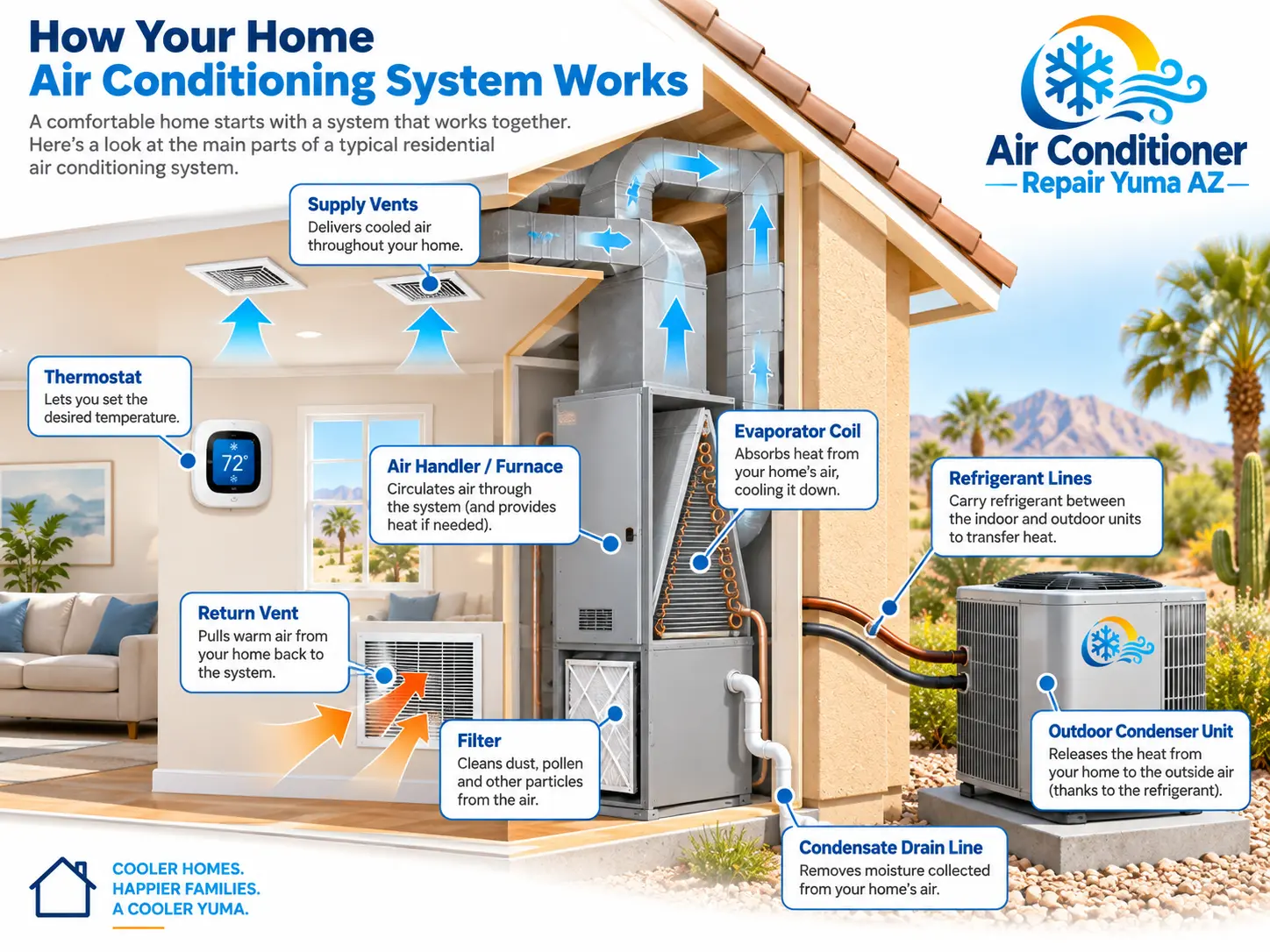
An air conditioner does not create cold; it moves heat from inside to outside. The outdoor coil has to hand that heat off to the surrounding air, and the ease of doing so depends on how much hotter the coil is than the air around it. When the outdoor air is extremely hot, the coil has to run hotter still, pressures rise, and the amount of heat the system can move per hour goes down.
At the same time, the home's heat gain goes up: more heat conducts through walls and windows, more radiates off hot roofs, and any duct running through a superheated attic loses more of what it carries. Capacity falling while load rises is the whole story of a Yuma afternoon.
Long run times and what they mean
In a mild climate, a cooling system cycles: run, satisfy, rest. In Yuma summer, running for very long stretches is normal, and continuous operation during peak hours does not by itself indicate a defect. The meaningful comparisons are year over year and time of day.
- Run time much longer than last summer at similar temperatures suggests lost capacity
- Indoor temperature that keeps rising while the system runs suggests a real fault
- A home that never recovers overnight suggests capacity, airflow or duct problems
- Struggling only after 3 p.m. points toward heat rejection and load
Yuma Climate Note
Heat and electrical components
Capacitors, contactors, relays and motor windings all age faster when they operate hot for long periods. This is why so many Yuma service calls in July involve a failed start component rather than a dramatic mechanical failure — the parts most exposed to heat and cycling are the ones that give out first. High amp draw from a system fighting a dirty coil accelerates the same process.
It also explains the pattern of failures right after a heat wave begins: components that were marginal in spring finally reach their limit when the system starts running fifteen or more hours a day.
The house is part of the system
Two identical systems in two identical-looking homes can perform very differently. West-facing glass, thin or displaced attic insulation, leaky duct runs above the ceiling, dark roofing, an unshaded exterior and added conditioned space all raise the load. In many homes the fastest comfort improvement is not equipment at all — it is duct sealing, insulation, or shading the windows that catch afternoon sun.
What you can control
- Keep filters clean; airflow is the homeowner's biggest lever
- Keep every register and return grille open and unobstructed
- Keep the outdoor unit clear of debris and maintain the manufacturer's recommended clearance so airflow stays unobstructed
- Shade sun-facing windows during the afternoon
- Avoid the oven and dryer during peak heat
- Set an achievable temperature rather than an aspirational one
- Report performance changes early, before the next heat wave
Technician Check
Heat & Performance FAQs
Questions about AC performance in extreme heat
Does an air conditioner lose capacity when it gets hotter outside?
Is it normal for my AC to run almost continuously in July?
Why can't my system reach a very low setpoint on the hottest afternoons?
Does extreme heat shorten equipment life?
What can a homeowner actually control?
Sources / Climate reference: Local climate normals, heat records and monsoon-season information for the Yuma area are published by the National Weather Service Phoenix/Yuma office at weather.gov/psr. Climate descriptions on this page are general and intended for homeowner context rather than as precise statistics.
24/7 Emergency AC Help Requests
Request help if your system is losing ground
Call to ask about current availability, or send your request and a participating independent provider may follow up.
Participating provider availability varies by location, demand and technician capacity.