
Air Filter Guide for Dusty Yuma Homes
The filter is the cheapest part of your cooling system and the one with the most influence on how it performs. In a desert climate it also loads far faster than most packaging assumes.
Participating provider availability varies by location, demand and technician capacity.
What the filter is actually protecting
Most homeowners think of the filter as an air quality device. It is that, but its primary mechanical job is protecting the equipment — specifically the blower wheel and the evaporator coil. Dust that gets past the filter lands on the wet coil and cements into place between the fins, where it reduces heat transfer and is expensive to remove. It also coats the blower wheel, which quietly reduces the amount of air the system can move.
That is why a cheap filter changed on time protects your system better than an excellent filter left in place far too long.
Filter types compared
- Fiberglass panel. Very low resistance, minimal filtration. Protects equipment only marginally and needs frequent replacement.
- Pleated disposable. The common residential choice. Available across a range of efficiencies, with reasonable filtration and manageable resistance.
- Deep media / cabinet filters. Large surface area, good filtration with lower resistance per unit of efficiency, longer service intervals. Requires the right cabinet.
- Washable / permanent. Reusable and cost-effective if cleaned diligently and dried fully; easy to neglect in heavy dust.
- Ductless head filters. Washable screens at each indoor unit, cleaned per the manufacturer's directions.
Ratings and the airflow trade-off
Filter efficiency ratings describe how well the media captures particles. Higher is not automatically better for your system, because denser media adds resistance, and cooling capacity depends on moving a specific volume of air across the coil. Push resistance too high and you get reduced capacity, longer run times and greater risk of coil freezing — a real problem dressed up as an upgrade.
The practical answer for most homes is a mid-range pleated filter, replaced on time, with more filter area rather than denser media if better filtration is wanted. A provider can tell you what your duct and filter cabinet arrangement can support.
Yuma Climate Note
Realistic Yuma intervals
- Check monthly during cooling season, without exception
- Check again after any significant dust storm
- Shorten the interval with pets, allergies, nearby fields or unpaved roads
- Expect faster loading in homes with leaky return ducts
- Deep media filters last longer but still need seasonal inspection
- After a vacancy, inspect before the first hard run of the season
Checking and changing it correctly
Homeowner Check
- Turn the system off at the thermostat before removing the filter
- Note the exact size printed on the frame before you buy replacements
- Hold the filter up to light — if the media is obscured, replace it
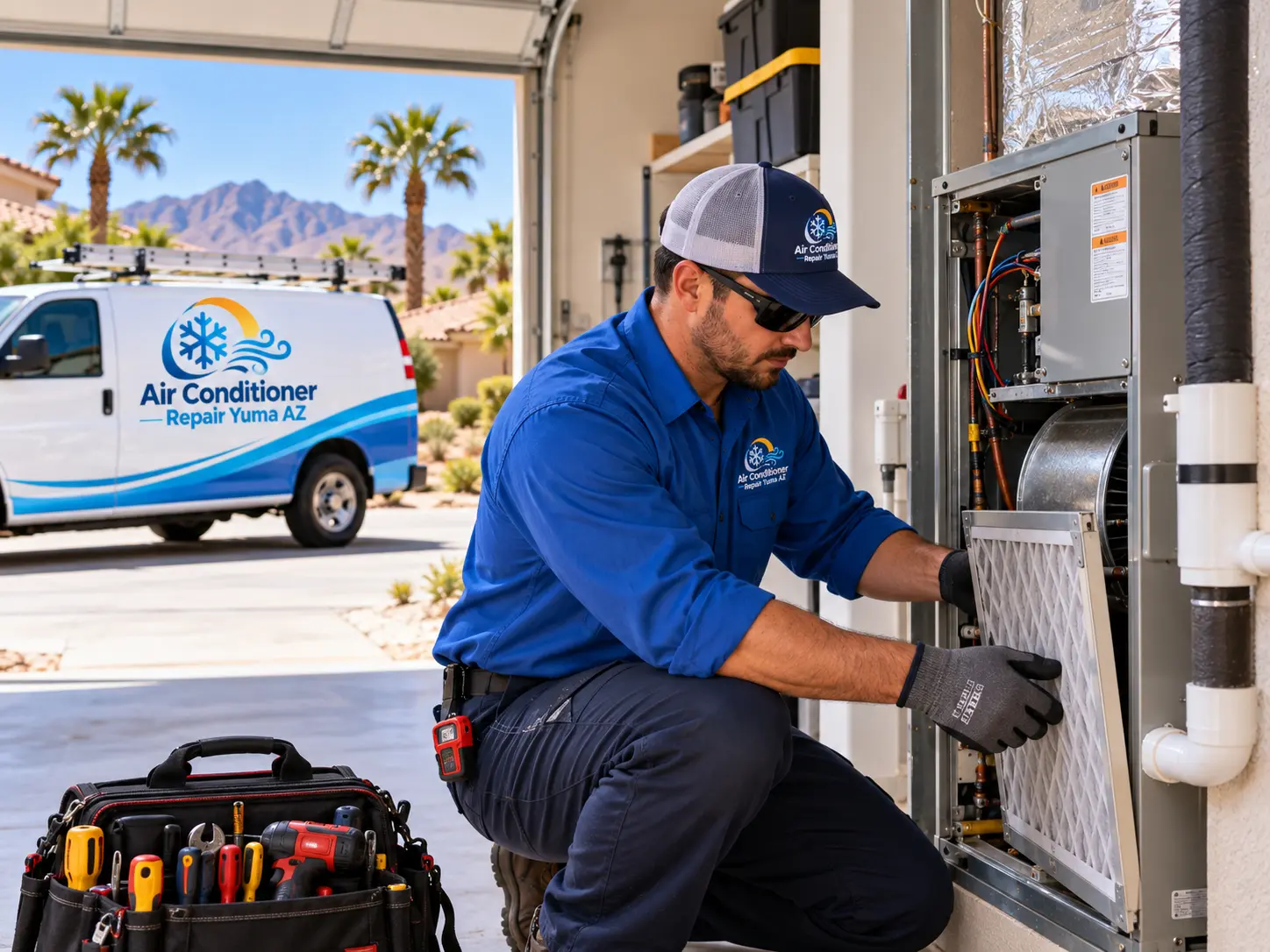
- Install with the airflow arrow pointing toward the equipment
- Make sure it seats fully; gaps let unfiltered air bypass the media
- Write the date on the frame so the next check is easy to judge
- Keep spares on hand so a loaded filter never stays in place
Technician Check
Filter FAQs
Questions about AC filters in desert conditions
How often should I change my filter in Yuma?
Is a higher-rated filter always better?
What filter rating should I use?
Do washable filters work well here?
Does filter size matter beyond fitting the slot?
Can the wrong filter freeze my coil?
Will a better filter help with allergies?
24/7 Emergency AC Help Requests
Request help if airflow still seems weak
Call to ask about current availability, or send your request and a participating independent provider may follow up.
Participating provider availability varies by location, demand and technician capacity.